Car Battery Dying? Signs, Free Test & What to Expect
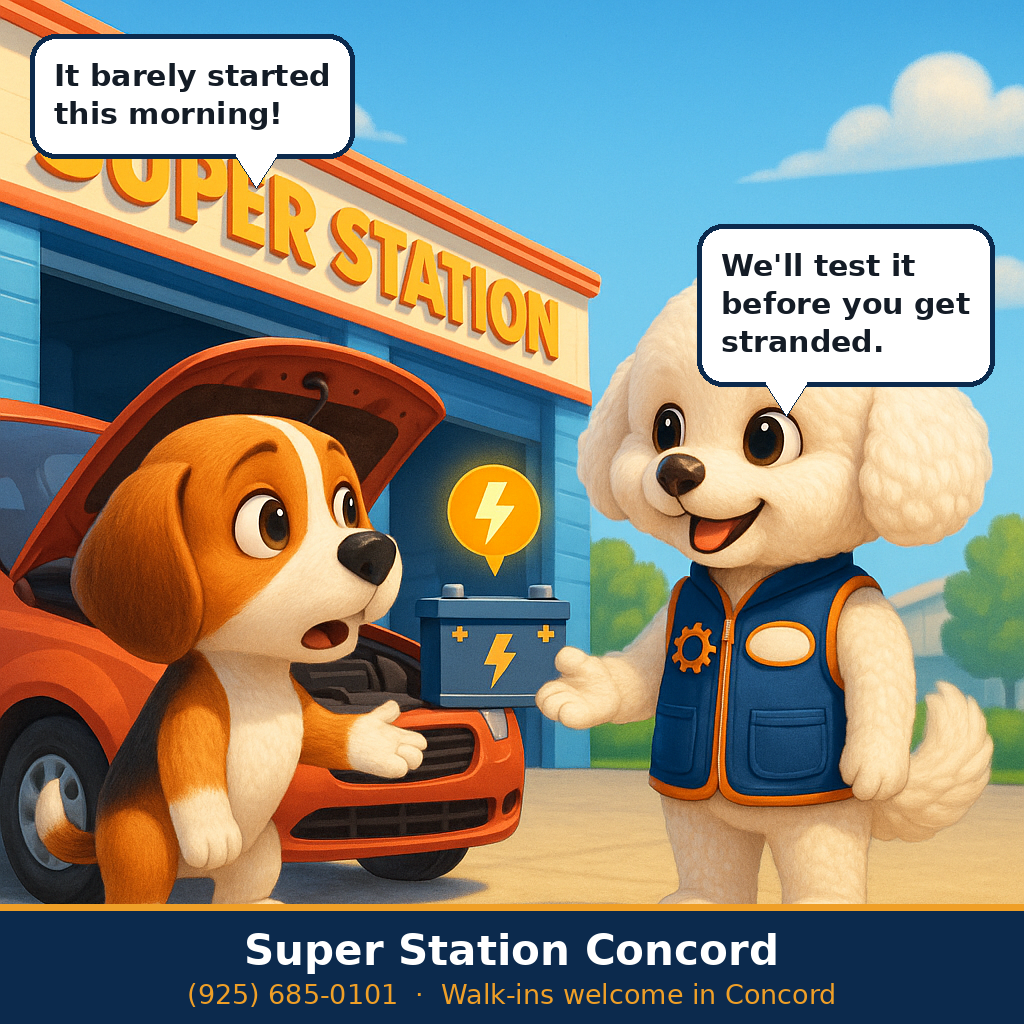
Every fall we see the same thing on Monument Boulevard: batteries that limped through a hot Concord summer finally quit on the first cool morning. It feels sudden, but a battery almost always gives warning first. Here's how to read the signs, what our free test actually checks, and what to expect if it's time for a replacement.
Six Signs Your Battery Is on Its Way Out
- Slow, labored cranking. The engine turns over like it's tired — "rur… rur… rur" instead of a quick start. This is the classic early warning, and it's usually worst on the first start of the day.
- Headlights dim at idle and brighten when you rev. The battery isn't holding enough charge to carry the load on its own.
- Electronics acting strange. Random dash warning lights, a radio that resets, power windows that crawl. Low voltage confuses modern car computers before it stops the engine.
- The battery warning light stays on. Despite the picture, this light usually points at the charging system (the alternator), not just the battery — which is why testing both matters.
- Corrosion or a swollen case. White or blue-green crust on the terminals, or a case that looks bloated, means heat has been cooking the battery from the inside.
- It's more than three years old. Even with no symptoms, a battery past its third East Bay summer is living on borrowed time.
Why Concord Heat Kills Batteries, Not Winter
People associate dead batteries with cold, and cold is when they fail — a cold engine needs more cranking power and a weak battery can't deliver it. But the damage is done in summer. Heat accelerates the chemical reactions inside the battery, evaporates electrolyte, and corrodes the internal plates. A battery that spent July and August baking in a parking lot on Clayton Road or the Sunvalley lot has aged more than one that lived in a cooler climate. Then the first 40-degree morning in November exposes the weakness.
That's why we tell customers to get tested in September or October — after the heat has done its damage, before the cold demands full power.
What Our Free Battery Test Actually Checks
A "free battery test" at a parts counter usually means a quick voltage reading. Ours is a full charging-system check, and it takes about 10 minutes — no appointment, drive up during business hours:
- Battery state of health under load — not just resting voltage, which can read fine on a battery that's about to fail.
- Alternator output — is it actually charging the battery while the engine runs?
- Starter draw — is the starter pulling more current than it should?
- Terminals and cables — corroded or loose connections cause more "dead battery" calls than people expect.
That last point matters. Earlier this year a customer brought in a Honda Accord that kept dying, convinced he needed an alternator. It was a loose battery cable. Sabi tightened it, charged nothing, and the car has been fine since. We'd rather find that than sell a part you don't need.
Battery or Alternator? How to Tell
The two failures feel almost identical from the driver's seat, and guessing wrong is expensive. A rough rule: if the car starts fine after a jump and keeps running, but won't start again the next morning, it's usually the battery. If the car dies while driving, or the battery light comes on and stays on with the engine running, suspect the alternator. But rules of thumb are just that — the test settles it in minutes, and if there's something deeper going on (a parasitic draw, a wiring fault), that moves to our diagnostics bay.
What to Expect If You Need a Replacement
Price depends on what your vehicle requires. A standard flooded battery for an older sedan is a very different part from an AGM battery for a newer car with start-stop, or the large-group battery a truck needs. Many newer vehicles also need the car's computer told about the new battery — called battery registration — so the charging system manages it correctly. Skip that step and a brand-new battery can be cooked by an over-eager alternator within a year.
We give you a written quote for your exact vehicle after the test, handle the registration and any resets, and most replacements are done within the hour when the battery is in stock. Details are on our battery & alternator service page.
Three Things That Extend Battery Life
- Drive it. Short trips — under 15 minutes — never fully recharge the battery. If your car mostly does school runs and grocery trips, take it on the freeway once a week.
- Keep the terminals clean. We check and clean them during every oil change as part of the multi-point inspection.
- Park in the shade when you can. It genuinely helps in August.
Q: My car is only two years old — can the battery really be bad?
A: Yes, especially if it sat on a dealer lot for months before you bought it, or if the car does mostly short trips. Age on the calendar isn't the whole story. If it's cranking slowly, get it tested regardless of age — the test is free and takes ten minutes.
If your car has been slow to start lately, don't wait for the morning it doesn't. Drive up to Super Station Concord at 1650 Monument Blvd during business hours for a free battery and alternator test, or call or text (925) 685-0101 and we'll tell you whether we have your battery in stock.